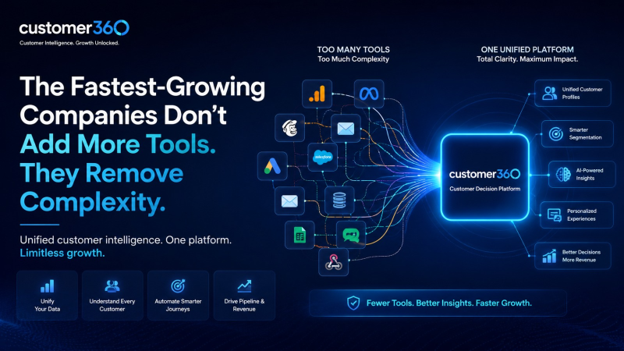
THE FASTEST-GROWING COMPANIES DON'T ADD MORE TOOLS.
THEY REMOVE COMPLEXITY.
A customer360.biz field guide to marketing tech stack consolidation, first-party data unification, and turning your martech spend back into revenue.
YOU ARE PAYING FULL PRICE FOR A MARKETING TECHNOLOGY STACK YOU USE ONE-THIRD OF
Here's the number that should be uncomfortable if you sign the renewal invoices: the average enterprise now runs roughly 90 to 120 marketing tools, drawn from a global martech market of over 15,500 solutions — a landscape that has grown more than 100x since 2011.
According to Gartner's most recent Marketing Technology Survey, organizations actually use only 49% of the capability they pay for. Utilization bottomed at 33% in 2023 and only 15% of organizations qualify as "high performers"— hitting strategic goals with positive ROI.
Martech now eats close to 22% of total marketing budget, while CMOs manage an average of nine channels simultaneously. Meanwhile, CAC has climbed 40–60% since 2023, and the median SaaS company spends $2.00 in sales & marketing to generate $1 of new ARR.
None of this is a story about weak campaigns. It's a story about decision latency: how long it takes to go from "a customer did something" to "we made the right call in response."
That latency is a direct function of how many disconnected systems your customer data travels through. Growth doesn't come from bolting on tool #91 — it comes from collapsing the distance between "we have the data" and "we made the decision." That's exactly what a unified customer decision platform like customer360.biz was built to solve.
So what? Every unused seat and duplicated capability is a direct tax on your CAC payback period. Consolidating the data layer doesn't just reduce license spend — it compresses the time from signal to decision, which is where ad-spend waste actually lives.
RUN A MARTECH AUDIT THAT ACTUALLY KILLS TOOLS — NOT JUST DOCUMENTS THEM
Most "stack audits" produce a spreadsheet nobody acts on. Do it as a capability-vs-utilization exercise instead — the way Gartner recommends to CMOs justifying (or defunding) their next renewal cycle.
THE FOUR-STEP AUDIT
- Inventory every tool by owner, not by department. Marketing, RevOps, and IT each think someone else owns 30% of the stack. Get one canonical list with a named human accountable for each contract.
- Map utilization against cost, not features. A $60K/year tool used by two people for one workflow isn't "powerful" — it's a $30K-per-user liability.
- Score each tool on data centrality. Does it originate customer data (source of truth) or consume data from elsewhere (satellite)? Satellites consolidate first.
- Flag redundant capability clusters. Most stacks have 3–4 tools doing segmentation, 2 doing attribution, and 2 doing on-site personalization — each with its own "customer."
PRO TIPDon't audit by asking "do we use this tool?" Ask "if this tool disappeared tomorrow, which specific revenue-driving decision would we be unable to make on time?" Tools that pass this test are infrastructure. Tools that don't are subscription debt.
So what? Killing three redundant satellites at $40K each isn't just $120K back in the budget — it's ~$120K of MER re-invested into channels that actually move CAC payback inside 12 months.
CONSOLIDATE AROUND A SINGLE CUSTOMER RECORD — NOT A SINGLE VENDOR
The instinct after an audit is often "let's find one mega-suite." That's a trap. Composable, best-of-breed execution tools (ad platforms, email send engine, CRM) should stay specialized. What needs to consolidate is the data layer underneath them.
HOW TO EXECUTE CORRECTLY
- Establish one unified customer profile every downstream tool reads from and writes to — the core function of a modern customer data platform (CDP) layer.
- Kill duplicate "source of truth" claims. If CRM, CDP, and ad platform each claim to know "who your best customer is," you have three truths and zero alignment.
- Standardize identity resolution first. Cross-channel attribution is mathematically impossible when the same human is three anonymous IDs across platforms.
- Push activation outward, don't pull reporting inward. Audiences, offers, and next-best-actions flow from the unified profile into paid, lifecycle, and sales sequences.
PRO TIPThe fastest way to spot a fake "unified view" in a vendor demo: ask what happens when a customer converts on paid, contacts support, then gets upsold by sales — does the same record update in real time across all three motions, or does someone reconcile it in a spreadsheet on Friday? If it's the spreadsheet, it's not unified.
So what? A unified profile removes the manual reconciliation tax (typically 6+ analyst hours/week) AND stops paid platforms from re-acquiring customers you already own — the single biggest hidden ROAS leak in most B2B stacks.
RE-ANCHOR EVERY TOOL DECISION TO CAC, LTV, AND MER
Procurement usually happens backwards: a team falls in love with a feature, then justifies the cost. Flip it. Every tool — existing or new — defends its seat using unit economics.
- Calculate loaded CAC impact, not sticker price. A $40K/year tool that shortens the sales cycle by 10 days is worth more than its price tag — cycle length is a direct CAC lever.
- Tie retention tools to LTV explicitly. Expansion revenue accounts for >33% of new ARR at median SaaS, and costs ~half as much to generate as new-logo ARR.
- Track MER at the stack level. It's common to optimize per-channel ROAS while total efficiency quietly degrades from tool overhead and manual reconciliation.
- Build a "cost-per-decision" metric. Divide total martech + ops spend by meaningful data-driven decisions shipped per quarter. Watch it fall as you consolidate.
PRO TIPCFOs don't care that a tool is "best-in-class." They care whether cutting it moves CAC payback the wrong direction. Frame every stack decision in payback-period language and you'll win the budget conversation almost every time.
So what? Every framework here rolls up to one dollar-denominated outcome — payback period. If a consolidation move doesn't shorten it, don't ship it.
REBUILD SALES–MARKETING ALIGNMENT AROUND SHARED DATA — NOT SHARED MEETINGS
Tool sprawl is one of the biggest hidden drivers of sales–marketing misalignment, because each team ends up trusting a different data source about the same prospect.
- Give RevOps ownership of the data layer, not just reporting. RevOps owns the unified record and the rules for how it flows between MAP, CRM, and CS tooling.
- Replace lead-scoring silos with one shared scoring model fed by the unified profile — "hot" in marketing equals "hot" in sales.
- Instrument the full lifecycle, not just the funnel. Pipeline, activation, expansion, and churn risk live on the same customer timeline.
- Set one shared efficiency metric — CAC payback period forces marketing and sales to jointly own front-end cost and back-end conversion speed.
PRO TIPIf sales and marketing are arguing about lead quality, the root cause is almost never effort — it's that they're scoring against two different data sets. Fix the data layer before you touch the SLA.
So what? Alignment isn't a culture project — it's a schema project. One customer record eliminates the argument, and every meeting that argument used to fill converts back into pipeline time.
A BEFORE / AFTER SCENARIO — MID-MARKET B2B SAAS, ~$18M ARR
- CDP-adjacent tool, email platform, ad platform audiences, BI layer, sales engagement, chat/support — each holding a partial, non-synced profile.
- Attribution reconciled manually every Monday — ~6 analyst hours/week.
- Blended CAC up in line with 40–60% market trend; leadership couldn't isolate market pressure from internal inefficiency (5–7 day reporting lag).
- Sales & marketing disagreed on lead quality in nearly every pipeline review.
- CAC payback period: ~19 months — outside the strong (12mo) and acceptable (18mo) ranges 2026 term sheets expect.
- Identity resolution + single profile eliminated the Monday reconciliation entirely — attribution became a live view.
- Audience activation to ads and lifecycle happened automatically off the same profile sales used.
- Decision latency dropped from days to same-day; adjustments happened as data changed.
- Sales cycle friction dropped as lead quality disagreements evaporated.
- CAC payback compressed toward 12 months — tool count fell, capability didn't.
The lesson isn't "fewer tools always wins." It's that decision speed and data trust compound, and every additional disconnected system taxes both.
GROWTH IN 2026 IS GATED BY DECISION SPEED — NOT PLATFORM COUNT
Over half of martech capability sits unused, martech eats nearly a quarter of the marketing budget, and CAC keeps climbing. The fastest-growing companies aren't the ones with the biggest stack — they're the ones who collapsed their stack into a single, trustworthy customer record and built speed on top of it.
That's the strategic bet behind customer360.biz: not another tool to manage, but the layer that makes the rest of your stack finally act like one system.
SOURCES & FURTHER READING
- Gartner, "Boost Martech Performance and Prepare for AI" — 2025 Marketing Technology Survey
- Chiefmartec / MartechTribe, "State of Martech 2026"
- CMSWire, "Peak Martech: 15,505 Tools, Almost Zero Growth"
- Benchmarkit, 2025 SaaS Performance Metrics
- GTM 8020 / Genesys Growth / Data-Mania / SaaSUltra — 2026 CAC benchmark reports
This article reflects publicly available market research current as of mid-2026. Figures vary by industry and stage — use them directionally.